Parts of a card
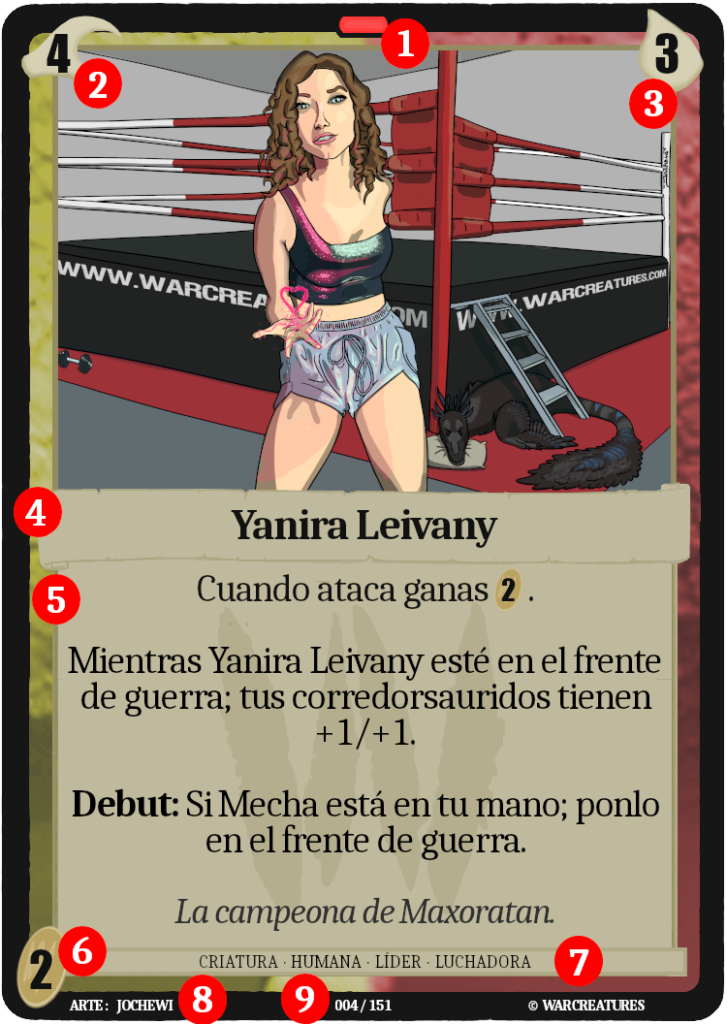
(1) Rarity: Rarity determines the number of copies of a card you can include in your deck. It is represented by colors: gray (common), green (rare), yellow (uncommon), orange (exceptionally rare), and red (unique). The maximum number of copies of each rarity can vary depending on the format, except for unique, which is limited to one copy per deck in all formats. There can also be no more than one copy of a unique card in play. When a unique card is played, if a copy of that card is already in play, the copy in play is removed.
(2) Atack: The damage points inflicted by the card in combat.
(3) Life/Resistance: The damage points that the card must receive to be eliminated.
(4) Name: The name of the card.
(5) Description: The skills and effects that the card has.
(6) Cost: The amount of coins that must be paid to play the card.
(7) Categories: The categories to which the card belongs. Each category has its own special rules.
(8) Art: The name of the artist who illustrated the card.
(9) Number in the collection: The card number in the collection to which it belongs.
The game
Game preparation
Before starting, players must ensure their decks meet the specific criteria of the agreed-upon format.
First, each player shuffles their deck and places it face down on the game board.
Players roll a die to determine turn order; the player with the highest roll goes first. Turns proceed counter-clockwise.
The first round
In the first round, the players steal
The start of your turn
Effects that take place at the start of your turn are resolved now.
Phase 1: Management
You draw a card, collect the number of coins indicated by your cards in play that generate coins, and remove a fatigue counter from each of your cards in play with fatigue counters.
Phase 2: War
During this phase you can:
· Play cards from your hand by paying their cost in coins.
· Activate your cards in play to develop your strategy or attack your opponent.
When you place or activate your cards on the war front, place a fatigue counter on them.
The end of your turn
Effects that take place at the end of your turn are resolved now.
Your opponent’s turn
Now it’s your opponent’s turn. You can play reaction cards during your opponent’s turn, during their management and war phases, as indicated in the description of your reaction cards.